I was building a new feature for Kezi the other day, and I did the thing I now do for anything with real moving parts. I reached for Spec Kit.
If you have not run into it, GitHub’s Spec Kit is an open-source toolkit for what they call spec-driven development. Instead of vibe-coding your way into a corner, you write the spec first, then let the AI coding agent turn that into a plan, and the plan into code. I use it with Claude. And here is a small choice that has mattered more than I expected: I wired the plan step up as a command I trigger myself, by hand, and only when a feature is genuinely complex. Not on every task. It is a deliberate “this one is worth a proper plan” move, so the ceremony earns its place instead of slowing down the small stuff.
So the plan came back. And it looked great. Clean, confident, reasonable.
That confidence is exactly the problem.
Because a plan that reads well is not the same as a plan that fits your codebase, your history, and where you are trying to go. The model writing it does not carry your roadmap in its head. It does not remember the design decision you made months ago and deliberately rejected. It is smart, and it is guessing.
So instead of accepting it, I asked Claude to review the plan with my architect agent. That agent is not a generic reviewer. It comes loaded with my context and my skills, the actual shape of the project, so it reviews against what I am building, not against what a plan should look like in the abstract.
The difference was immediate.
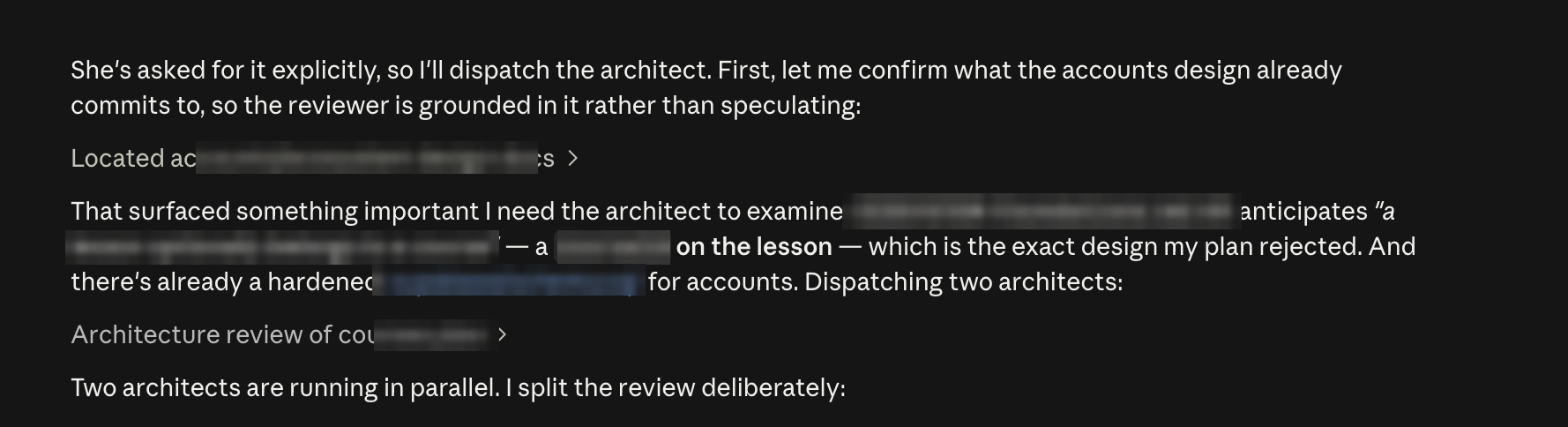
The first thing it did was refuse to speculate. It went and grounded itself in the design the project already commits to, and only then started reviewing. Right away it caught assumptions the plan had made wrong. It noticed that one step would quietly reintroduce a data-model decision that an earlier, approved plan had deliberately thrown out, sitting right next to a piece of schema I had already hardened. That is the kind of thing that does not blow up today. It blows up in a few months, as a refactor you never budgeted for.
I told it what I actually wanted. Not “make it perfect,” but make sure any change was conscious and justified against my context, not an automatic refactor for its own sake. It took that seriously enough to split the job, and dispatched two architects in parallel: one reviewing the new plan, one grounding in what the existing design already promises.
Then it came back.
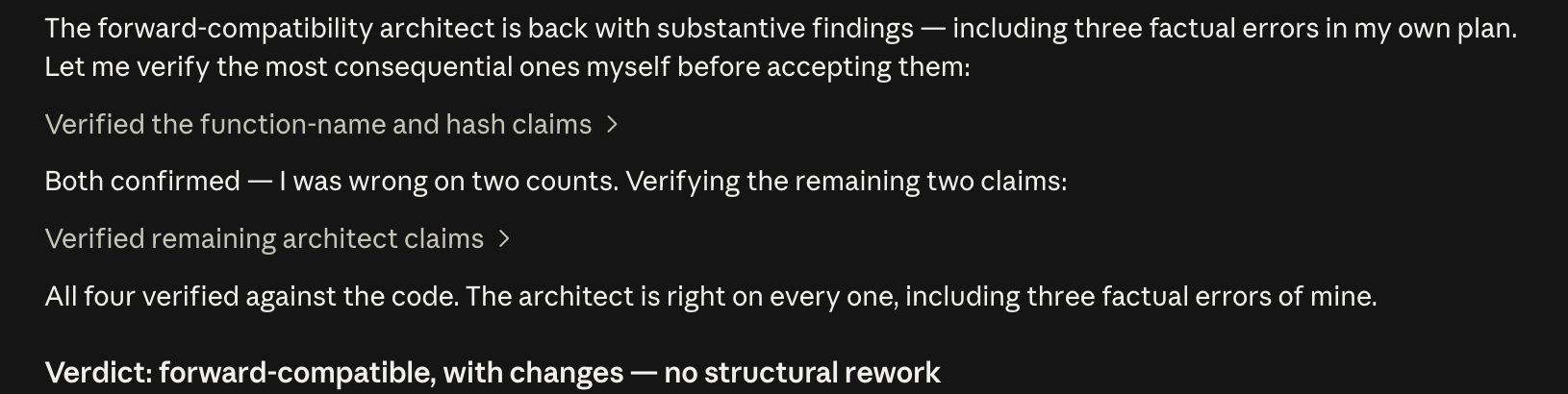
It had found substantive problems, including three factual errors in the plan itself. Not vibes, not “consider maybe,” actual wrong claims. I did not just wave it through. I am also not going to pretend I sat and read every line of code myself, because I cannot. What I did was read the new research and plan docs the architect produced, and check its reasoning against what I already know about the project and where it is going. It held up. Including on all three of my own mistakes.
The verdict at the end was the best outcome I could have asked for: forward-compatible, with changes, no structural rework. In other words, we can build this, we do not have to tear anything down, and here are the specific, deliberate adjustments that keep it that way.
Here is what I take from the whole thing, and it is the same idea from my last post. AI did the work. It wrote the spec, drafted the plan, ran the review, caught the errors. But the judgment calls were mine. I decided this feature was complex enough to earn a real plan. I decided not to trust that plan on sight, and to send it to my architect agent instead. And I decided the review was worth reading properly before I acted on it. The agent had good judgment about the code because I had handed it my context. The judgment about when to slow down and check was the human part.
That is the loop that actually matters now. Not “let the AI do it,” and not “do it all yourself.” It is this: feed the tool your real context, let it do the heavy lifting, and stay the human who checks the answer. The plan is cheap. Being right about the plan is still yours.
I could have shipped the pretty version and paid for it later. Instead I shipped the true one. That trade, a few minutes of review against a quarter of refactoring, is the easiest one I make all week.